

From Nam Lan road to Nam Dang classroom
08:53 AM 22/10/2026 Views: 5 PrintA road facilitating smoother transport of agricultural produce, a school site repaired in a timely manner, a domestic water supply facility continuing to serve local residents - the inspection conducted by the state management agency in charge of ethnic affairs in Vo Lao commune clearly reflects the tangible transformations driven by the national target program for socio-economic development in ethnic minority and mountainous regions (Program 1719). At the same time, it highlights the need for rigorous management, regular maintenance, and close supervision to ensure post-investment sustainability.
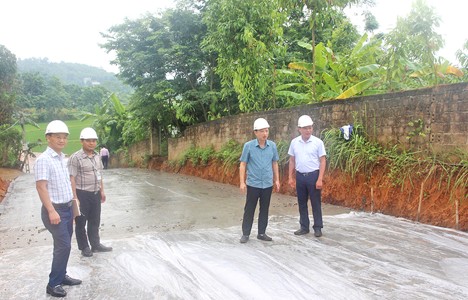
Newly completed road facilitates convenient travel, agricultural transport, and goods circulation for residents in upland villages and hamlets
A road opening new production opportunities
Vo Lao commune was established following the merger of three communes: Vo Lao, Nam Ma, and Nam Dang. The commune spans over 15,282 hectares with a population of 18,106. Prior to village consolidation, the commune had 38 villages, including 21 extremely disadvantaged villages. Steep terrain and frequent impacts from storms, floods, and landslides make transportation infrastructure both a vital livelihood necessity and an indispensable foundation for economic development.
In Nam Lan village, the newly built road has brought remarkable improvements to daily travel and trade. Speaking with Mr. Phùng Văn Chiêu - a Dao ethnic person, and Head of the village Triệu Văn Đức, the working delegation of the Ministry of Ethnic and Religious Affairs (MERA) noted that the project effectively meets transport needs and ensures safer, more convenient travel, especially during the rainy season.
The value of the road extends well beyond reducing travel time. Enabling farm produce to be transported outward more easily reduces transit costs and expands market access, thereby directly stimulating production and improving living standards for the local community.
Notably, numerous households in the village voluntarily donated land for the road construction. This active involvement demonstrates that local residents are not merely passive beneficiaries, but co-decision-makers and direct contributors to the project. This community ownership is essential for ensuring long-term responsibility in safeguarding and maintaining the infrastructure after handover.
The Nam Lan story mirrors the broader achievements of Program 1719. Lao Cai provincial Department of Ethnic and Religious Affairs previously recorded more than 366 infrastructure projects invested across the province prior to the administrative restructuring up to the end of 2024, among which rural transport was a prominent category. Nevertheless, effectiveness cannot be judged merely by the sheer number of projects; it must be assessed through their practical service to the people and their tangible contribution to local socio-economic development.
Classrooms repaired in good time
At Nam Dang Kindergarten, maintenance and repair works have been fully inspected, accepted, handed over, finalized for payment, and assigned to the school for management. According to Vice Principal of the school Phạm Thị Minh Thu, prompt repairs have enhanced physical facilities, fostering a safer and more supportive environment for nurturing, caring for, and educating children.
For a school site in a disadvantaged area, maintenance items may not be massive in scale, but they directly affect the daily activities of teachers and pupils. Timely maintenance also prevents further structural deterioration, saving substantial refurbishment costs in the long run.
Inspections revealed that project documentation is largely comprehensive, and the project scale, location, and objectives are appropriate. With the school acting as the designated management entity, operational responsibility is clearly defined. This is a pivotal factor, as post-investment difficulties often stem not from construction itself, but from the absence of a designated management body or a coherent maintenance plan.
Nonetheless, school needs remain ongoing. The school leadership recommended continued support to upgrade the kitchen area and sanitation facilities to fully improve childcare conditions. This proposal underscores that public investment should be based on real deficits and appropriately phased, avoiding situations where new issues emerge in adjacent facilities immediately after one item is completed.
Efficiency must be verified post-handover
Alongside Nam Lan road and Nam Dang Kindergarten, maintenance and operation records for the Nam Ken domestic water supply facility were also inspected. Local villagers reported that the facility operates reliably, consistently meeting daily water demands.
Spot-checking records for three other projects, the landslide prevention embankment for the multi-purpose cultural house of the former Nam Dang commune, the Nam Dam road, and the Nam Ken intra-village road, the MERA working delegation acknowledged that the commune properly established a community investment supervision board, drafted monitoring plans, and documented construction processes. Transparency, democracy, and community-level oversight were effectively exercised across sample dossiers.
However, supervision should not conclude once construction finishes. Local residents and the community investment supervision board must continue assessing operational quality, reporting defects, and monitoring maintenance work. The Vietnam Fatherland Front, village heads, and reputable individuals can serve as vital conduits to relay feedback swiftly from beneficiaries to local authorities.
The three projects in Vo Lao demonstrate that resources from the national target program yield optimal results when they address genuine needs, foster citizen participation, and establish a clear post-investment management entity. Conversely, projects lacking upkeep, operational data, or post-handover inspections will struggle to maintain enduring value.
Project efficiency must ultimately be gauged through tangible questions: Does the new road make commodity transport easier; are classrooms safer; does the water supply operate steadily through the dry season; and are local people satisfied and committed to preserving the infrastructure together? That is how monitoring and inspection fulfill their ultimate objective: ensuring that every dong invested brings meaningful change to community life.
Thuần Linh
THỐNG KÊ TRUY CẬP
Số lượt truy cập hiện tại: 28
Tổng số truy cập: