

Program 1719 resources bring effective change at the grassroots level
12:42 AM 01/09/2026 Views: 40 PrintFrom central policies to the advisory, guidance and inspection work of the local ethnic and religious affairs sector, National Target Program 1719 has helped transform ethnic minority and mountainous areas in Lao Cai province. Its results in poverty reduction, income, transport, electricity, water, education and health care have laid an important foundation. They have also revealed gaps that need continued priority in the new period.
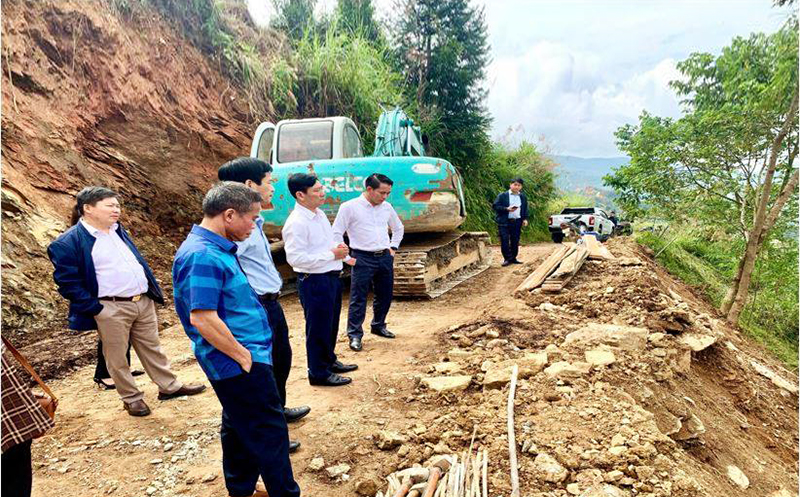
Roads in Bac Ha commune, Lao Cai province, built with Program 1719 funding, have improved travel, production and the movement of goods
After the merger, Lao Cai province covers more than 13,256 km² and has a population of nearly 1.78 million. More than 1 million of them are ethnic minority people, accounting for 60.9% of the province’s population. Of its 99 commune-level administrative units, 95 communes are in ethnic minority and mountainous areas, including 47 Region III communes. The province has 2,438 villages in ethnic minority and mountainous areas, of which 1,033 are extremely disadvantaged.
Because of the province’s large area and scattered population, infrastructure investment costs in highland areas are often high, while access to basic services still varies among localities. In this context, the results of the National Target Program on Socio-Economic Development in Ethnic Minority and Mountainous Areas for 2021–2025 (Program 1719) are reflected not only in the funding allocated, but above all in direct changes in people’s lives.
According to the Lao Cai provincial People’s Committee, as of early July 2026, 23 of the 32 targets were expected to meet or exceed the goals for the whole period. All communes have asphalt or concrete roads to their centers, 90% of villages have hard-surfaced roads to their centers, and 98% of communes have permanent health stations.
Access to electricity and clean water has also improved. An estimated 99% of households use the national grid or other suitable power sources, and 98.6% of ethnic minority people use hygienic water. The average income of ethnic minority people in 2025 was estimated at over 33 million VND per person per year, about double the level at the start of the period.
Total central budget funding for the program in the province for 2021–2025 was more than 6.309 trillion VND, of which nearly 5.423 trillion VND, or 85.96%, has been disbursed. The disbursement rate reached 96.9% for development investment capital and 72.6% for non-business capital. This gap shows that, alongside clear results in infrastructure, direct support for people, communities and livelihoods still needs a stronger push.
These figures are the result of many works, projects and support models at the grassroots level. By the end of 2024, in Lao Cai province before the merger, the program had invested in more than 366 infrastructure works, including power lines, roads, schools and health stations. It also helped build 27 centralized water supply works and provided water tanks and pipes to over 8,000 households. Models for growing medicinal herbs, raising cattle and poultry, and preserving cultural villages linked with community-based tourism have opened new ways to develop production and create livelihoods.
Besides the 23 targets expected to be met or exceeded, Lao Cai has identified eight targets that will be difficult to achieve. They include the rate of communes and villages exiting extremely disadvantaged status; the rate of ethnic minority people with access to television and radio; the allocation of residential and farming land; the rate of health insurance coverage; and population rearrangement and stabilization. Support for career conversion will continue in 2026.
The gap between the province’s overall results and the specific needs of each area remains quite large. Some highland areas still lack water in the dry season, the power grid is unstable, and infrastructure is damaged by flash floods and landslides. In the first six months of 2026 alone, natural disasters affected 6,701 houses, more than 1,190 hectares of farmland and many essential infrastructure works in the province.
The effectiveness of production support projects is also uneven. Many enterprises and cooperatives leading production linkages are small, and markets remain unstable. Lengthy appraisal procedures sometimes fail to keep pace with crop seasons. Linkages between project leaders and local people lack binding commitments, while some community members have not fully played their role as the main actors in designing and implementing projects.
Notably, the planned structure of Component 2 for 2026–2030 leans heavily toward infrastructure. Of the 103 projects proposed by the province, 94 are for building and completing specific infrastructure. Only nine aim to support production, create livelihoods and raise incomes, and they mainly focus on cultural preservation linked with tourism.
This means the province must keep investing in essential works without reducing the development goals for ethnic minority and mountainous areas to infrastructure alone. Roads, schools and water works only bring real value when they are linked with livelihoods, jobs, market access and people’s ability to improve their own lives.
The results of Program 1719 provide a foundation for Lao Cai to enter a new period with higher goals. For 2026–2030, the province aims to raise the average income of ethnic minority people from 33 million VND to 60 million VND per person per year and to basically eliminate extremely disadvantaged communes and villages. It will also continue to improve housing, population arrangement, water supply, electricity, transport and digital services.
To make these goals achievable, investment lists should be ranked by level of need and number of beneficiaries. Priority should go to the 47 Region III communes, the 1,033 extremely disadvantaged villages, border areas and areas at high risk of landslides and flash floods. Each project must clearly define its outputs, beneficiaries, operation plan, maintenance funding and direct impact on income and living standards.
Experience from the past period shows that resources are used more effectively where Party committees and authorities take strong action, specialized agencies closely follow central guidance and regularly inspect and remove obstacles, and local people are informed, consulted and involved in supervision. In the first six months of 2026, the provincial Department of Ethnic and Religious Affairs set up inspection teams and working groups to review preparations in 16 key communes. This helped localities identify early difficulties related to project lists, documents, beneficiaries and implementation progress.
Therefore, the next stage of Program 1719 in Lao Cai should be assessed not only by the number of completed works or the disbursement rate. The ultimate measure must be the number of households with clean water, stable electricity and good roads; the number of jobs and livelihoods created; improved incomes; and the satisfaction of people in the most disadvantaged areas.
Hương Huyền
THỐNG KÊ TRUY CẬP
Số lượt truy cập hiện tại: 31
Tổng số truy cập: