

Proactively addressing challenges in state management of belief and religion at the grassroots level
04:50 PM 24/08/2026 Views: 87 Print
Deputy Minister of Ethnic and Religious Affairs Nguyễn Hải Trung extends congratulations to outstanding groups and individuals of the Executive Committee of the Vietnam Buddhist Sangha in Phú Thọ province
Safeguarding people's freedom of belief and religion while upholding legal discipline, religious solidarity and social stability remains a consistent priority in the state management of belief and religion. As increasingly diverse issues arise at the grassroots level, the Ministry of Ethnic and Religious Affairs has focused on guiding local authorities to closely monitor developments, enhance the capacity of officials, assist religious organizations and individuals in complying with regulations, and promptly address difficulties encountered in administrative procedures. In Phú Thọ province, a proactive approach involving close monitoring of local developments, stronger coordination and direct guidance at the grassroots level during the first half of 2026 helped address emerging issues, process most administrative applications ahead of schedule and prevent the emergence of complex religion-related flashpoints.
State management of belief and religion is directly associated with people's rights and legitimate religious needs, while also involving various sectors, including land administration, construction, culture, foreign affairs, security and public order. Effective management is therefore measured not only by the issuance of regulatory documents or the timely processing of administrative procedures, but also by the ability to identify emerging issues early, provide guidance in accordance with regulations and appropriately address matters arising at the grassroots level.
These requirements have become increasingly evident since the two-tier local government model came into operation, with responsibilities reassigned to local authorities and commune-level administrations taking on a growing number of tasks involving citizens and religious organizations. Against this backdrop, the Ministry of Ethnic and Religious Affairs plays an important role in providing policy direction, professional guidance, monitoring and inspection to ensure that state management is conducted consistently, efficiently and in compliance with the law.
Closely Monitoring Local Developments and Addressing Issues at an Early Stage
Experience in Phú Thọ indicates that issues related to belief and religion at the grassroots level are becoming increasingly diverse. In addition to routine religious activities, these include the repair, renovation and construction of places of worship; religion-related land matters; activities involving foreign elements; the registration and notification of religious activities; concentrated religious gatherings; and emerging belief and religious phenomena.
According to a report by the Phú Thọ provincial Department of Ethnic and Religious Affairs, the situation concerning belief and religion across the province remained generally stable during the first six months of 2026. Belief and religious establishments continued their activities, while religious dignitaries, functionaries and followers participated in social activities and local movements. Competent authorities proactively monitored and coordinated efforts to address several potentially complicated cases, contributing to maintaining stability and preventing the emergence of religion-related flashpoints.

An incense-offering ceremony in honor of National Ancestor Lạc Long Quân and Ancestral Mother Âu Cơ at the Hùng Kings Temple Historical Site in Phú Thọ province. (Photo: vtv.vn)
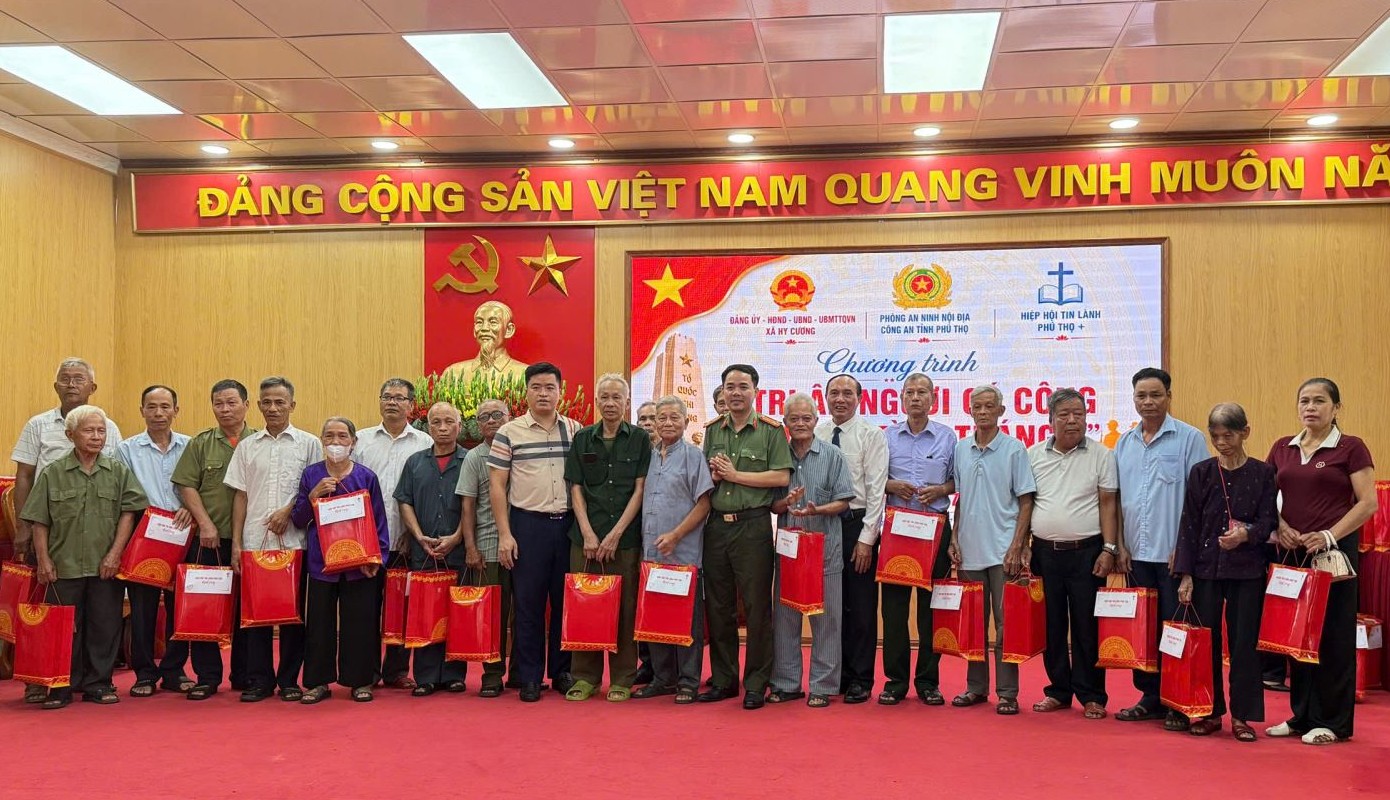
Representatives of several Protestant denominations in Phú Thọ province present 100 gifts to 100 policy beneficiary families and people who have rendered meritorious service to the nation, in response to the movements promoting gratitude and remembrance of those who have contributed to the country. (Photo: Phú Thọ Provincial Police Portal)
A notable feature of the province's approach is its emphasis on early intervention at the grassroots level. Immediately after the two-tier local government model became operational, the Phú Thọ provincial Department of Ethnic and Religious Affairs closely followed the programs, plans and guidance issued by the Ministry of Ethnic and Religious Affairs and the Government Committee for Religious Affairs. On this basis, the Department advised on and issued documents to guide implementation, while maintaining close monitoring of local developments and providing timely guidance whenever issues arose.
One direct support channel maintained by the Department is its telephone hotline. Through this channel, local officials responsible for religious affairs, religious dignitaries, functionaries and followers can seek clarification and assistance regarding professional matters and administrative procedures. This arrangement allows uncertainties concerning procedures, application requirements and jurisdiction to be clarified at an early stage, thereby reducing repeated requests for additional documentation and preventing minor difficulties from developing into more complicated cases.
At the same time, the Department has issued or contributed to numerous guidance documents for commune-level People's Committees and religious organizations and individuals concerning the reconstruction, repair, restoration and construction of belief and religious establishments. It has also guided religious dignitaries and functionaries in completing required documentation, coordinated the management of religious activities involving foreign elements, and supported preparations for the Congress of the Vietnam Buddhist Sangha's Phú Thọ provincial chapter for the 2026–2031 term.
These practical experiences demonstrate that monitoring developments in the state management of belief and religion involves more than simply collecting information. More importantly, it requires accurately identifying the nature of each issue, determining the competent authorities, proactively coordinating among relevant agencies and guiding grassroots authorities toward solutions consistent with the law.
Preventing Administrative Procedures from Becoming Bottlenecks
One of the essential requirements of state management of belief and religion is to maintain legal discipline while facilitating the exercise of the right to freedom of belief and religion by organizations and individuals in accordance with the law.
During the first six months of 2026, the Phú Thọ provincial Department of Ethnic and Religious Affairs advised on the processing of 19 administrative applications related to Buddhism and belief activities. Of these, 18 were processed ahead of schedule, while the remaining application, which fell under the authority of the provincial People's Committee, was submitted for consideration and handling in accordance with regulations.
These results highlight the benefits of shifting from an administrative approach primarily focused on processing applications toward proactive guidance before and during the implementation of administrative procedures. When organizations and individuals receive comprehensive information and appropriate guidance on documentation requirements, procedural steps and competent authorities, state management agencies can shorten processing times and minimize the need to return applications or repeatedly request additional documents.
This is also an important direction in the Ministry of Ethnic and Religious Affairs' approach to state management. Alongside developing and improving the institutional and legal framework, the Ministry is responsible for providing professional guidance, monitoring the implementation of policies and laws in localities, promoting administrative reform, and promptly compiling practical issues for submission to competent authorities for consideration and resolution.
These requirements have become even more pressing as the 2026 Law on Belief and Religion is scheduled to take effect on January 1, 2027. The new Law further promotes decentralization and delegation of authority, simplifies administrative procedures, encourages the application of information technology and introduces additional provisions to address emerging practical issues, including belief and religious activities in cyberspace.
To ensure the consistent implementation of the new provisions, the preparatory period before the Law takes effect is particularly important. The Ministry of Ethnic and Religious Affairs is continuing to develop detailed regulations, implementation measures and guidance documents. Local authorities, meanwhile, are required to review their professional procedures, prepare their personnel and anticipate potential difficulties arising from decentralization and the delegation of authority.
Experience in Phú Thọ also shows that certain issues in religious management are interdisciplinary and cannot be addressed solely through legislation on belief and religion. Matters involving land, the construction of religious establishments, the activities of religious organizations, religious practices involving foreign elements and emerging belief and religious phenomena all require coordination among multiple agencies.
Addressing difficulties at the grassroots level, therefore, does not mean relaxing regulations. Rather, it involves identifying the appropriate legal provisions, competent authorities and procedures for handling each matter, thereby safeguarding the lawful rights and interests of organizations and individuals while maintaining the effectiveness of state management.
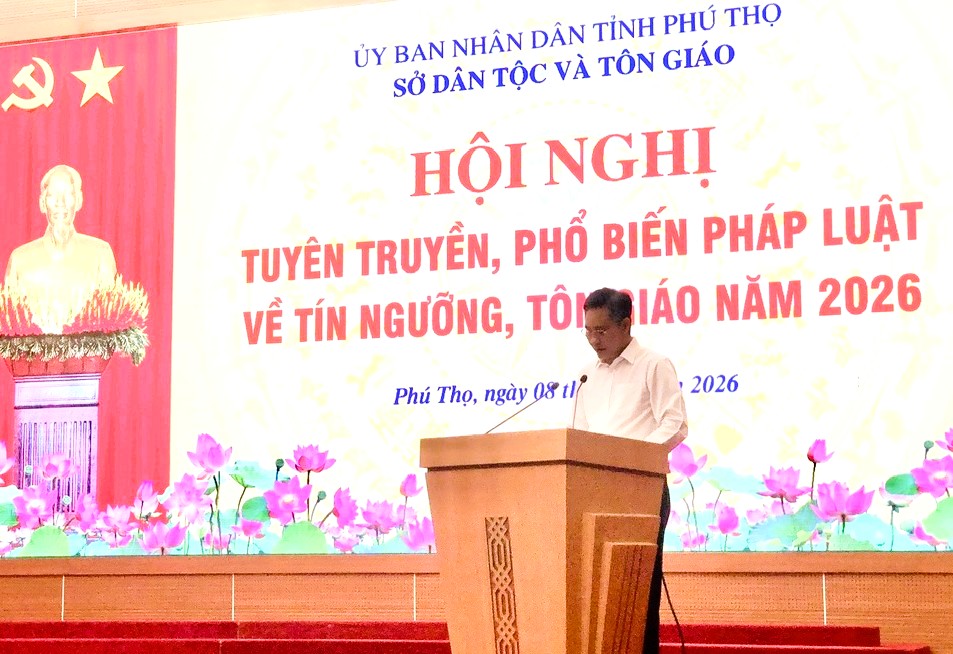
A conference on the dissemination of laws on belief and religion held in Phú Thọ province in 2026
Strengthening Commune-Level Capacity and Delivering Guidance Where It Is Needed
One of the challenges identified by Phú Thọ is the uneven professional capacity of officials responsible for belief and religious affairs at the commune level. Some officials concurrently perform other duties, lack continuity in their assignments and have limited experience in professional procedures and practical problem-solving. In certain localities, the approach to religious affairs remains overly reliant on administrative measures, while inspection, follow-up supervision and the review of practical experience have not always been conducted in a timely manner.
This issue requires particular attention as state management responsibilities are increasingly brought closer to the grassroots level. When authority is decentralized without corresponding improvements in implementation capacity, the risk of inconsistent interpretations and practices among localities may increase. Misinterpretation of an application, inflexible handling of a situation or delays in interagency coordination can directly affect the rights and interests of citizens and religious organizations, as well as the effectiveness of state management.
Accordingly, alongside improving the institutional framework, the Ministry of Ethnic and Religious Affairs has identified education, professional development, training and technical guidance as important priorities. Such guidance must closely reflect situations commonly encountered by grassroots officials, particularly in determining jurisdiction, following administrative procedures, managing religious activities involving foreign elements and activities in cyberspace, addressing land and construction matters related to belief and religious establishments, and coordinating responses to complicated cases.
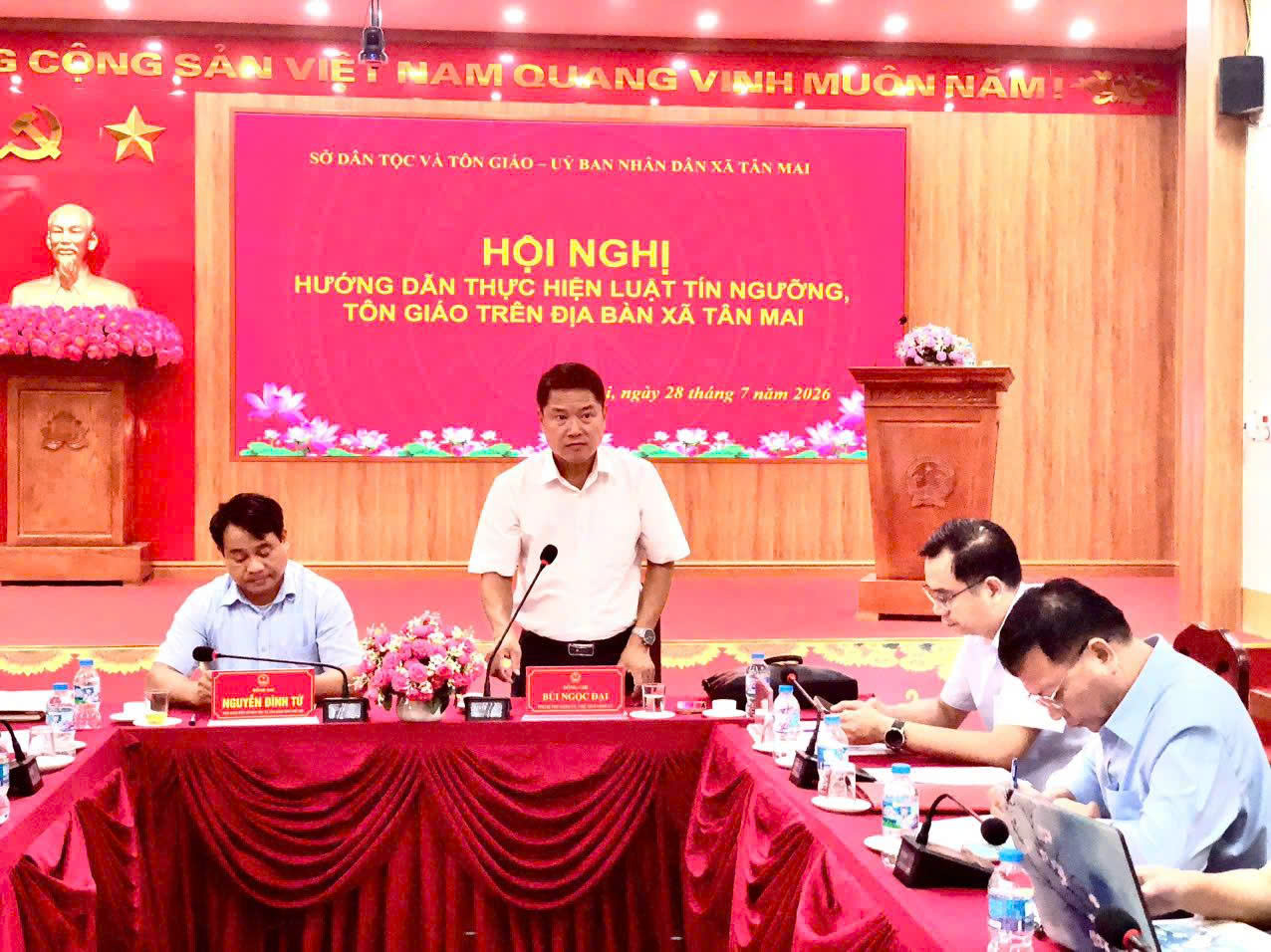
Leaders of the Phú Thọ provincial Department of Ethnic and Religious Affairs hold a working session with the People's Committee of Tân Mai commune on the implementation of the Law on Belief and Religion
In Phú Thọ, provincial authorities have issued a plan for the professional training and development of officials responsible for belief and religious affairs in 2026. They are also implementing the project entitled "Improving the Effectiveness of State Management of Belief and Religion in Phú Thọ Province for the 2026–2030 Period." During the second half of the year, the province continues to prioritize professional training for officials and the dissemination of legal regulations among religious dignitaries, functionaries, practitioners, followers and representatives of belief establishments.
Alongside personnel training, maintaining a mechanism for regular information exchange between central and local authorities is of practical importance. Difficulties arising at the grassroots level need to be promptly compiled and clearly categorized into matters that fall within local authorities' jurisdiction, those requiring professional guidance and those warranting further research to improve policies.
From a state management perspective, this process also helps incorporate practical experience into policymaking. Issues relating to administrative procedures, the division of responsibilities, religious activities in cyberspace, religious practices involving foreign elements, and land and construction matters, when fully reported from the grassroots level, provide valuable information for the Ministry of Ethnic and Religious Affairs to further improve its guidance documents and propose appropriate mechanisms and policies.
Phú Thọ has also proposed expanding professional training and development courses for officials responsible for ethnic, belief and religious affairs at all levels, while studying and recommending improvements to special funding mechanisms for religious affairs in line with practical requirements. These proposals demonstrate that addressing difficulties at the grassroots level should extend beyond resolving individual cases to tackling systemic challenges involving institutions, resources and implementation capacity.
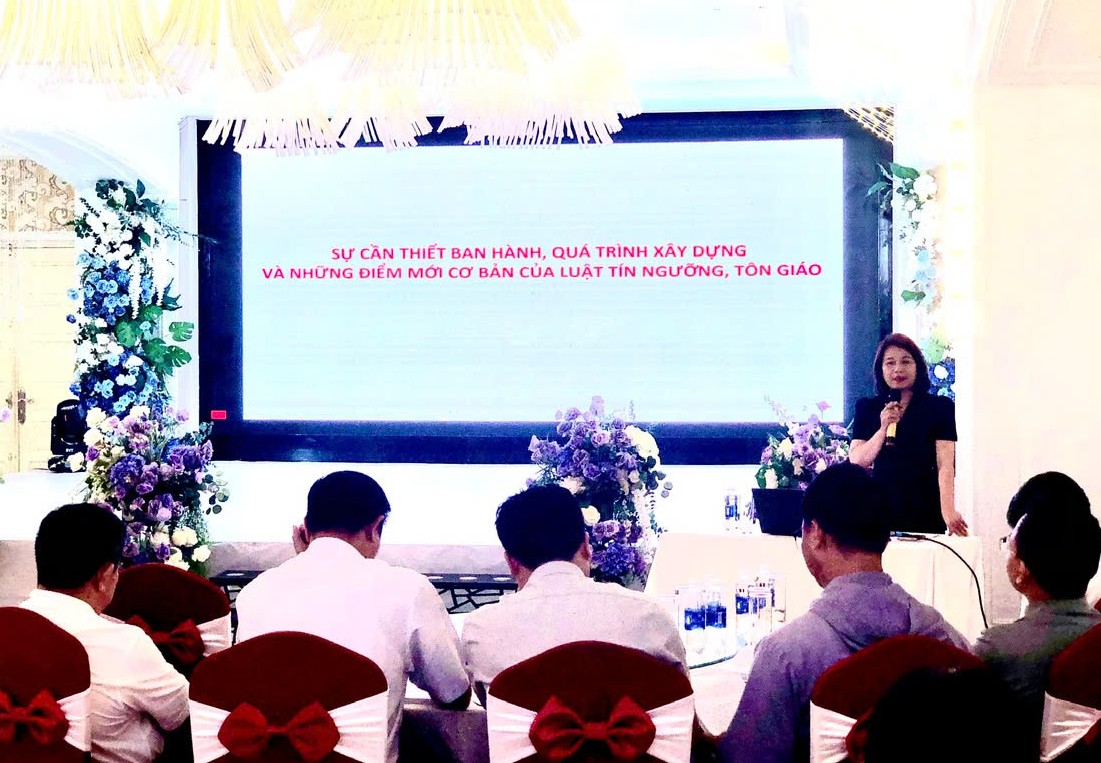
Dr. Nguyễn Thị Định, Head of the Division for Belief and Other Religions under the Government Committee for Religious Affairs, disseminates the Law on Belief and Religion among Catholic and Protestant dignitaries, functionaries and followers in the Hòa Bình area of Phú Thọ province
Looking ahead, state management of belief and religion must continue to ensure consistency between policy formulation at the central level and implementation in localities. The Ministry of Ethnic and Religious Affairs will continue to strengthen its role in providing policy direction, improving the legal framework, offering professional guidance, and monitoring and inspecting implementation. Local authorities, for their part, need to proactively monitor developments, enhance dialogue and coordination, and address issues directly at the grassroots level.
When guidance reaches the localities where difficulties arise, grassroots officials have a firm understanding of the law, and religious organizations and individuals receive appropriate assistance in complying with regulations, state management can move beyond merely responding to problems after they occur. More importantly, this approach can establish mechanisms for prevention and early resolution, safeguarding people's right to freedom of belief and religion while maintaining legal discipline, religious solidarity and social stability.
Thành Long
THỐNG KÊ TRUY CẬP
Số lượt truy cập hiện tại: 40
Tổng số truy cập: