

Prioritizing domestic water, electricity, and population stabilization in Lao Cai highlands
03:34 PM 22/10/2026 Views: 22 PrintFollowing a comprehensive review, Lao Cai Province has proposed 266 urgent projects with a total capital requirement of approximately 811 billion VND, focusing on domestic water, electricity, population stabilization, and natural disaster prevention. The scale of this demand highlights that basic shortages remain prevalent across many upland areas, while underscoring the need for targeted investment, linking infrastructure construction with long-term operation and disaster resilience.
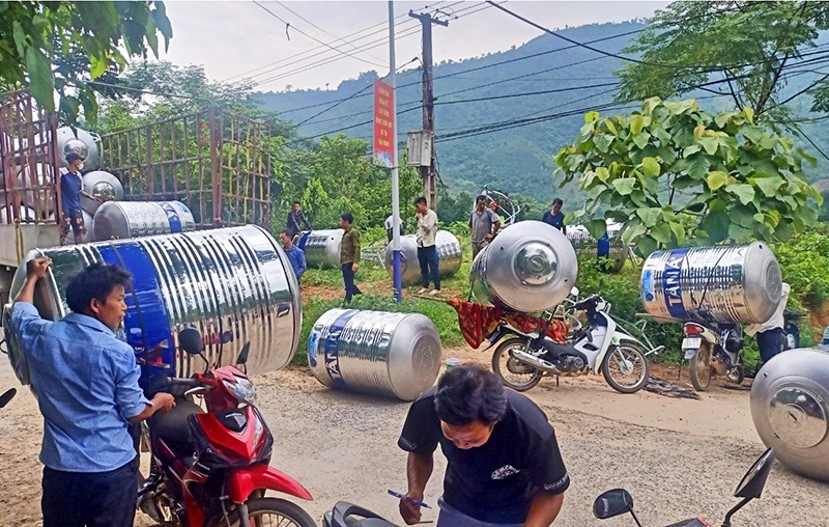
Providing water storage tanks helps upland households proactively store domestic water during dry season
Domestic water: the most pressing need
Lao Cai has 95 communes in ethnic minority and mountainous regions, including 47 Zone III communes (extremely disadvantaged communes) and 1,033 extremely disadvantaged villages. High, rugged, and fragmented mountainous terrain, dispersed settlements, and the increasingly evident impacts of climate change make ensuring domestic water, electricity, and safe housing a persistent challenge.
Based on local reviews, the provincial Department of Ethnic and Religious Affairs has synthesized reports and advised the provincial People's Committee to propose 266 urgent projects with an estimated total capital requirement of 811,003 million VND. Among these, 117 domestic water supply projects require approximately 413,357 million VND; 128 domestic power supply projects require about 287,116 million VND; and 21 projects for natural disaster prevention, population arrangement and stabilization, and other urgent needs require around 110,530 million VND.
Domestic water accounts for more than half of the total capital demand. Many facilities have degraded and operate inefficiently, while the rate of access to clean water meeting standard regulations remains low. In several upland areas, particularly in limestone mountain regions such as Pha Long and Cao Son, water resources become exceptionally scarce during the dry season.
Vo Lao Commune serves as a specific case in point. Upland villages in the former Nam Ma and Nam Dang areas often suffer severe water shortages in the dry season due to the depletion of natural mountain springs. Steep, degraded farmland and a lack of irrigation water not only disrupt daily living conditions but also constrain livelihood development.
Over recent years, resources from the National target program for socio-economic development in ethnic minority and mountainous regions (Program 1719) have generated significant improvements. By the end of 2024, across Lao Cai Province, the Program had supported the construction of 27 centralized domestic water supply facilities and distributed water storage tanks along with water pipes to over 8,000 households. While this establishes an essential foundation, the newly proposed portfolio indicates that substantial tasks lie ahead, especially in areas heavily impacted by drought, landslides, and flash floods.
From "having infrastructure" to "securing stable services"
Investing in water supply across upland areas cannot merely be measured by the number of completed projects. A system may reach structural completion but still deliver poor performance if water sources are unstable, technology is unsuitable, management personnel are lacking, or maintenance budgets are absent.
Therefore, each water supply project must clarify its intake source, water quality, number of beneficiary households, treatment technology, operational entity, usage regulations, and maintenance funding sources from the outset. Response plans for droughts, floods, and landslides must also be integrated into the engineering designs. A facility lacking designated operational management and a post-investment operational plan cannot be considered to have accomplished its goal.
Regarding domestic electricity, the current challenge extends beyond simply connecting power lines to remote villages. Although most localities have access to the national grid, several clusters of households in remote and isolated areas still experience unstable power supply; aging and subpar electrical grids fail to meet daily life and production needs. Consequently, the 128 proposed power projects are primarily aimed at renovation, upgrading, and ensuring safety and stability.
A stable electricity supply is also a prerequisite for schools, commune health stations, water supply systems, telecommunications infrastructure, and production models to operate effectively. Treating electricity as an isolated item rather than aligning it with broader community development needs will inevitably restrict investment efficiency.
Population stabilization must go hand in hand with livelihoods
During the first six months of 2026, Lao Cai experienced six natural disaster events, impacting 6,701 houses, more than 1,190 hectares of agricultural land, and numerous essential infrastructure works. Steep gradients, dense river and stream networks, and extreme weather patterns render landslides and flash floods constant hazards in many residential clusters.
Resettling populations, therefore, is not merely a matter of moving a household out of a danger zone. New resettlement sites must guarantee legal residential land, water, electricity, roads, schools, healthcare services, and sustainable production conditions. Lacking viable livelihoods, residents struggle to settle long-term and may even return to hazardous old areas to farm.
The portfolio of 21 projects for natural disaster prevention, population stabilization, and other critical needs must be prioritized according to risk levels and their capacity to directly safeguard the lives and properties of local residents. High-risk landslide zones, border regions, areas enduring prolonged water shortages, and locations with wide gaps in access to essential services must be addressed first, avoiding uniform, equal distribution based solely on administrative boundaries.
Drawing from the experience of previous phases, achieving genuine investment efficiency requires substantial community participation. Local residents must be provided with transparent information, participate in site selection, deliberate on management options, and supervise construction. Following project handover, each asset must possess full documentation, a designated operational entity, a routine maintenance schedule, and a clear mechanism for reporting breakdowns.
The capital requirement for the 266 proposed projects stems from actual local demand, which does not imply that all works will be funded concurrently. The priority is to establish a transparent ranking of urgency and determine solutions tailored to each locality. Once clean water, stable electricity, and safe shelter are secured, local communities will have a firm foundation to expand production, ensure quality schooling for children, and bolster collective resilience against natural disasters.
Thuần Linh
THỐNG KÊ TRUY CẬP
Số lượt truy cập hiện tại: 30
Tổng số truy cập: