

Ministry holds workshop on job creation, service development and sustainable labour market linkages in ethnic minority and mountainous areas for 2026–2035
03:40 PM 12/08/2026 Views: 53 PrintThe Ministry of Ethnic and Religious Affairs held a workshop in Lai Châu province on August 11, 2026, to assess the current situation and propose solutions for job creation, service development and sustainable labour market linkages in ethnic minority and mountainous areas for the 2026–2035 period.

An overview of the workshop
The workshop aimed to provide input for the development of a project on job creation, service development and labour market linkages in ethnic minority and mountainous areas for 2026–2035. Deputy Minister of Ethnic and Religious Affairs Nông Thị Hà chaired the event.
The workshop brought together representatives of the Departments of Home Affairs, Ethnic and Religious Affairs, Agriculture and Environment, Culture, Sports and Tourism, Science and Technology, Finance, Industry and Trade, Education and Training, and Health of Lai Châu province, as well as representatives of several commune-level People's Committees in the province.
Also attending were representatives of the Departments of Home Affairs, Ethnic and Religious Affairs, and Agriculture and Environment from Sơn La, Phú Thọ, Tuyên Quang, Lào Cai and Điện Biên provinces, along with representatives of the Vietnam Academy for Ethnic Minorities.

Deputy Minister Nông Thị Hà delivers remarks at the workshop
Addressing the workshop, Deputy Minister Nông Thị Hà emphasised that ethnic affairs and the implementation of ethnic policies are the responsibility of the entire Party, people, armed forces and political system. She stressed that the development of ethnic minority and mountainous areas is a long-term strategic task of particular importance to political stability, sustainable development and the consolidation of great national unity.
The Deputy Minister noted that the implementation of various programmes and policies in recent years has brought about positive socio-economic changes in ethnic minority and mountainous areas. Infrastructure has gradually improved, poverty rates have declined, and the quality of education, healthcare services and people's living standards has been enhanced.
Grassroots political systems have been strengthened, national defence and security have been maintained, and ethnic minority communities' confidence in the Party and State has increased.
Nevertheless, as Vietnam enters a new phase of development, the 2026–2035 period is expected to bring emerging trends that present both opportunities and challenges for ethnic minority and mountainous areas.
In guiding the discussions, Deputy Minister Nông Thị Hà called on delegates to focus on assessing the current state of employment, service development and labour market linkages in ethnic minority and mountainous areas.
She also urged participants to propose practical solutions to harness local potential, attract investment and create employment opportunities for ethnic minority communities, thereby improving people's living standards, promoting economic development, and contributing to social stability and the maintenance of public order in border areas.
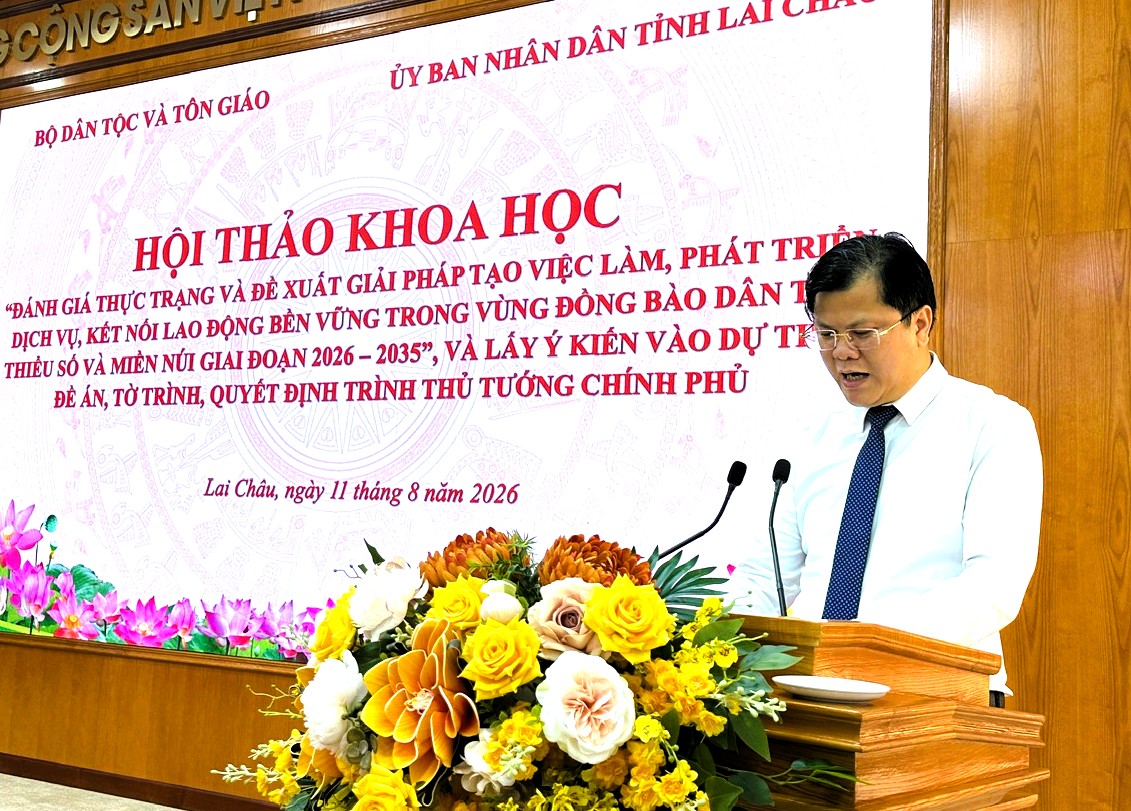
Nguyễn Đức Thuận, Deputy Director of the Lai Châu provincial Department of Ethnic and Religious Affairs, speaks at the workshop
During the workshop, delegates discussed practical issues relating to the current situation, regional potential and advantages, as well as opportunities for livelihood development and job creation through the implementation of employment policies in ethnic minority and mountainous areas.
Discussions also focused on career guidance and vocational training aligned with employment demand and service development within the education system in ethnic minority and mountainous areas.
Other topics included tourism development and the preservation and promotion of ethnic minority cultural values; research on cultural preservation and the registration and protection of intellectual property rights associated with ethnic minority communities, contributing to socio-economic development in Lai Châu province; and the impacts of international integration and advances in science and technology on ethnic minority and mountainous communities.
Nguyên Hải
THỐNG KÊ TRUY CẬP
Số lượt truy cập hiện tại: 53
Tổng số truy cập: