

Experience exchange in Phu Tho province on developing set of indicators serving direction and administration of leaders of ministry of ethnic and religious affairs
05:08 PM 22/09/2026 Views: 36 PrintTransitioning from traditional paper-based reporting and static forms to a governance and administration model driven by digital data is an urgent requirement for state management agencies today. To realize this objective, a working delegation of the ministerial-level scientific research project titled “Research and proposal of a set of indicators serving the direction and administration of leaders of the Ministry of Ethnic and Religious Affairs in the digital environment” conducted a field survey in Phu Tho province.
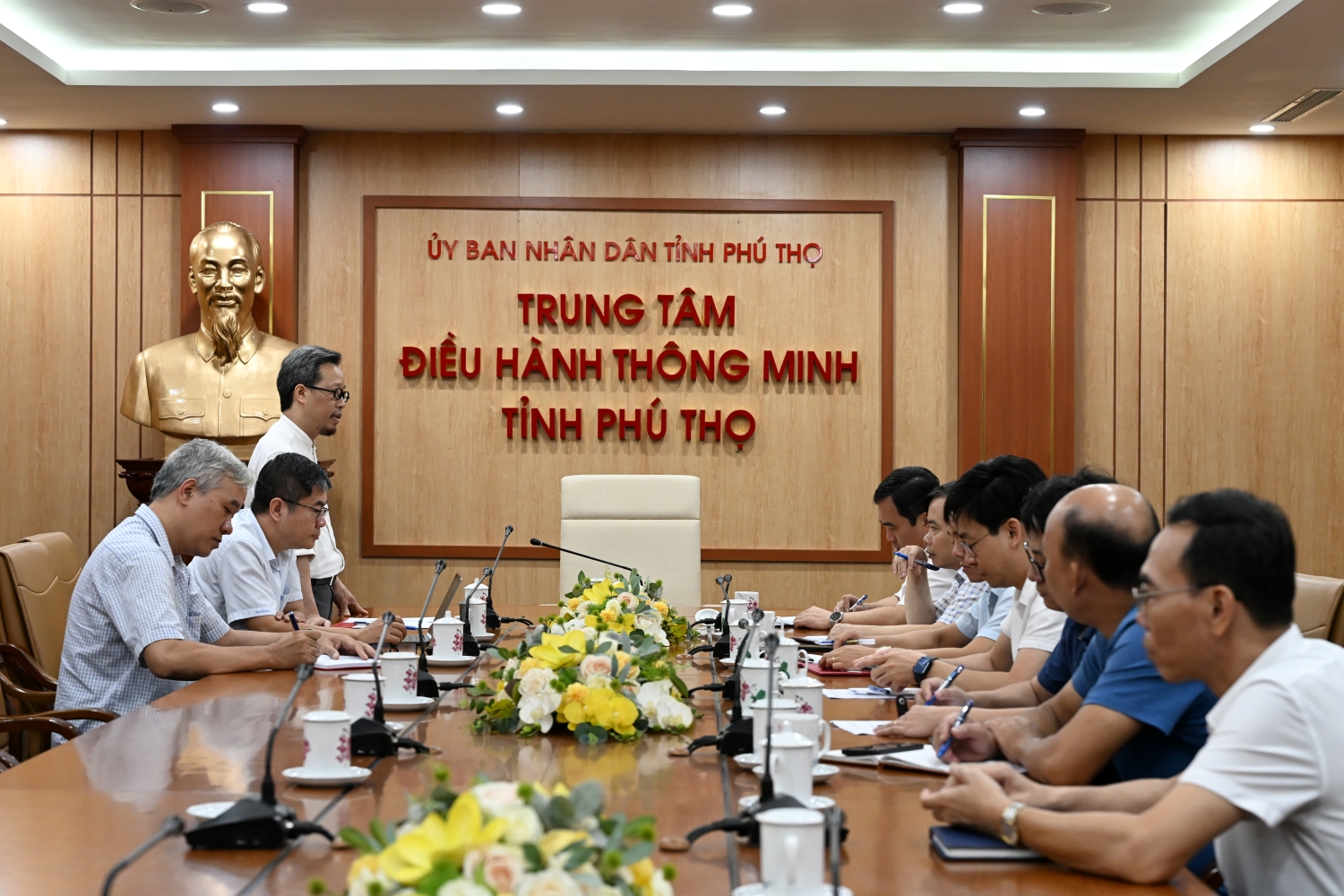
Working delegation of Ministry of Ethnic and Religious Affairs works at People’s Committee of Phu Tho province
The Working delegation was led by Dr. Lê Trung Kiên, Deputy Head of the Division of General Affairs, Communications, and Emulation - Commendation (Ministry Office) cum Scientific Secretary of the Research project, alongside representatives from the Ministry Office, the Center for Digital Transformation, and the Vietnam Academy for Ethnic Minorities.
Speaking in Phu Tho province, Dr. Lê Trung Kiên affirmed that developing a Set of Indicators serving direction and administration in the digital environment is not merely a mechanical compilation of forms, but rather an effort to establish an objective, transparent, and scientific tool for measuring public service performance.
The head of the working delegation outlined the key issues for discussion and collaboration with the province, including: criteria for selecting indicators; barriers encountered when shifting toward output-based public service management; capacity for data collection and quality control; information groups requiring prioritized and regular monitoring; the list of indicators serving emergency situations; feasible data update frequencies for the grassroots level; solutions for ensuring information safety and security; and inter-agency operational coordination mechanisms between the central and local levels.
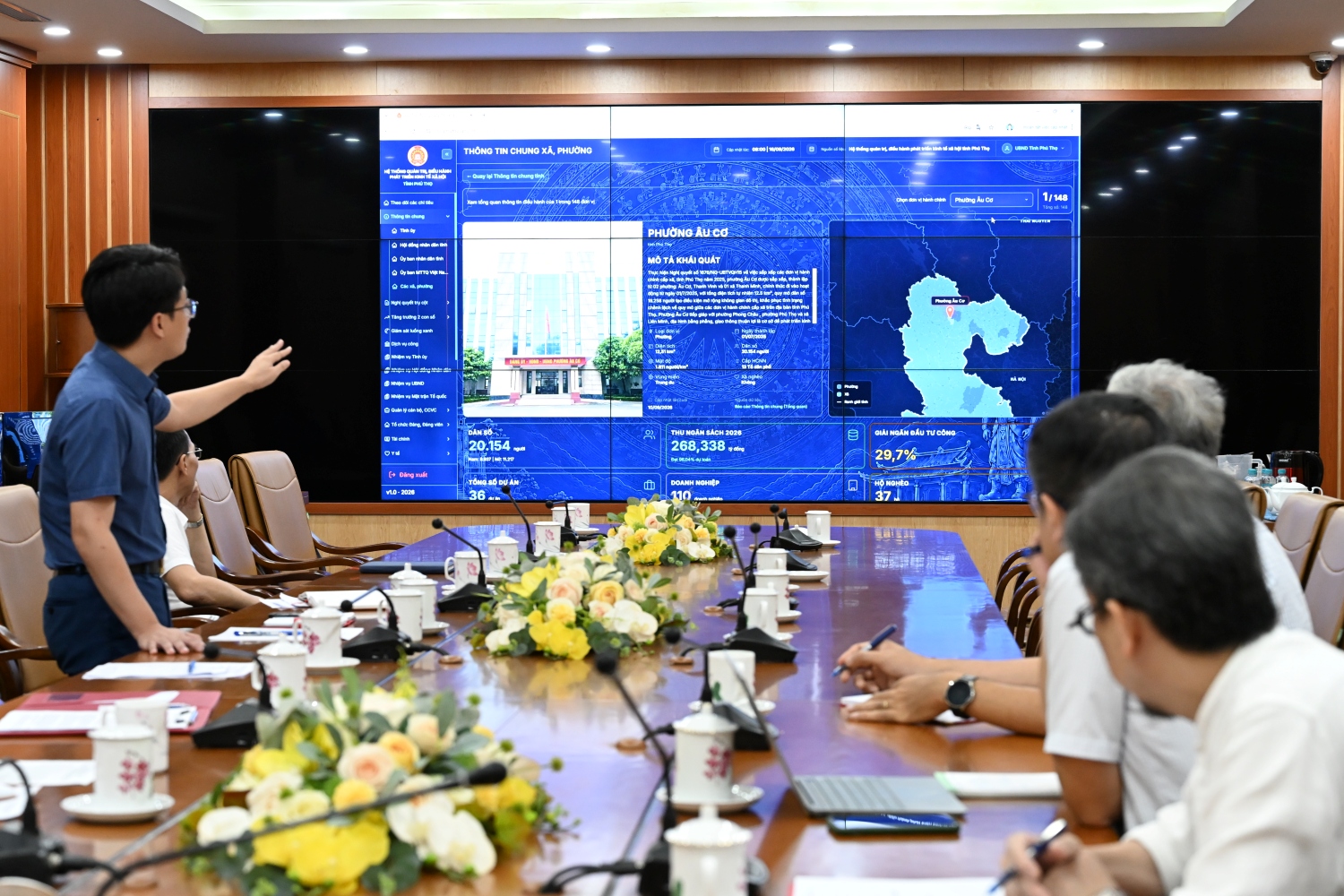
An official of the province delivers presentation on the province’s pilot system for data-driven socio-economic administration
Field survey at Phu Tho provincial intelligent operations center
During the working session at the headquarters of the Office of the provincial People’s Committee, the working delegation directly inspected the pilot system for data-driven socio-economic administration, which serves as the foundational model advancing toward the Intelligent Monitoring and Operations Center (IOC).
The province’s dashboard system is designed with approximately 25 functional modules covering four agency blocs: the Party, the Provincial People’s Council, the Provincial People’s Committee, and the Provincial Committee of the Vietnam Fatherland Front. Among these, the province has piloted six modules featuring automated real-time connectivity via Application Programming Interfaces (APIs).
Concurrently, the provincial People’s Committee has promulgated a catalog of 198 databases belonging to provincial departments, boards, and sectors, as well as 148 communes and wards, to implement a peak campaign consolidating all primary data into a shared data warehouse.
Phu Tho’s governance experience demonstrates that linking indicators with public service accountability has generated marked improvements in task execution. Through the online-integrated I-Office Electronic Document Management and Executive Administration System, all directives and conclusions issued by the Standing Board of the provincial People’s Committee to each agency and unit are assigned specific completion deadlines. The system automatically classifies task statuses as completed on time, completed overdue, or uncompleted, serving as a basis for periodic evaluation of public service performance.
In addition, rather than dispersing resources, the province focuses its executive dashboard on key economic indicators serving double-digit growth targets, such as public investment disbursement progress, state budget revenue and expenditure, and site clearance progress for key projects.
Seminar on developing and implementing set of indicators serving direction and administration of Phu Tho provincial leaders and Lessons for Ministry of Ethnic and Religious Affairs
Contributing insights at the seminar from practical experience in advising on state management in ethnic and religious affairs, Mr. Nguyễn Hồng Quân, Deputy Chief of Office of the Phu Tho provincial Department of Ethnic and Religious Affairs, provided a detailed analysis of two core data groups serving provincial leaders: baseline data on the development of ethnic minority areas and data on state management of beliefs and religions.

Deputy Chief Nguyễn Hồng Quân speaks during the seminar discussions
He noted that the greatest difficulty currently faced at the local level is the shortage of dedicated information technology (IT) personnel. Following organizational apparatus streamlining, the Department of Ethnic and Religious Affairs no longer holds a dedicated staffing quota for IT, while officials in charge of this domain at the commune level mostly serve in a part-time (concurrent) capacity. Furthermore, transmission infrastructure in remote and isolated areas remains limited, a large volume of legacy data has yet to be digitized, and barriers regarding data entry authorization persist.
Deputy Chief of Office Nguyễn Hồng Quân proposed that the data collection process serving the Set of Indicators must adhere to the principle of centralized uniformity, whereby data updated from the grassroots level must pass through automated verification and cross-checking layers against national databases prior to official exploitation. At the same time, the central level needs to provide shared software solutions and organize data-processing skills training for local officials.

Head of the Division of Buddhist and Belief Affairs Nguyễn Thị Hương Lan delivers remarks at the seminar
Offering a deeper analysis of specialized domain characteristics, Ms. Nguyễn Thị Hương Lan, Head of the Division of Buddhist and Belief Affairs under the provincial Department of Ethnic and Religious Affairs highlighted the sensitivity of the sector and the stringent requirements for the protection of state secrets in the field of beliefs and religions. She emphasized that evaluation indicators must be carefully selected to ensure measurability without creating unnecessary complexity for management work. Moreover, uploading specialized operational information onto a shared system requires perfecting the legal framework, implementing security encryption, and establishing strict access authorization mechanisms to prevent the risk of information leaks.
Regarding the update frequency for specialized data, Head of the Division of Buddhist and Belief Affairs Nguyễn Thị Hương Lan recommended conducting updates on a quarterly basis to ensure accuracy and alignment with the data synthesis capacity at the grassroots level.
Practical lessons drawn from disaster and flood response situations affecting ethnic minority communities were also analyzed by delegates to clarify the gap between ad-hoc information demands and grassroots response capacity. While leaders of state management agencies require rapid daily or hourly damage figures, commune-level officials in charge of ethnic affairs cannot maintain a 24/7 duty roster for data entry like specialized forces in the agriculture or health sectors. The submission of reports by communes at varying timestamps also easily leads to discrepancies in data aggregation. Therefore, delegates agreed that the optimal solution is not to impose an additional separate manual reporting regime on the ethnic affairs sector; rather, central agencies should establish an inter-connected mechanism to share primary data directly from the agriculture and disaster prevention sectors so that information can be automatically extracted to serve direction and administration.
Lessons for designing set of indicators serving the direction and administration of Ministry of Ethnic and Religious Affairs’s leaders
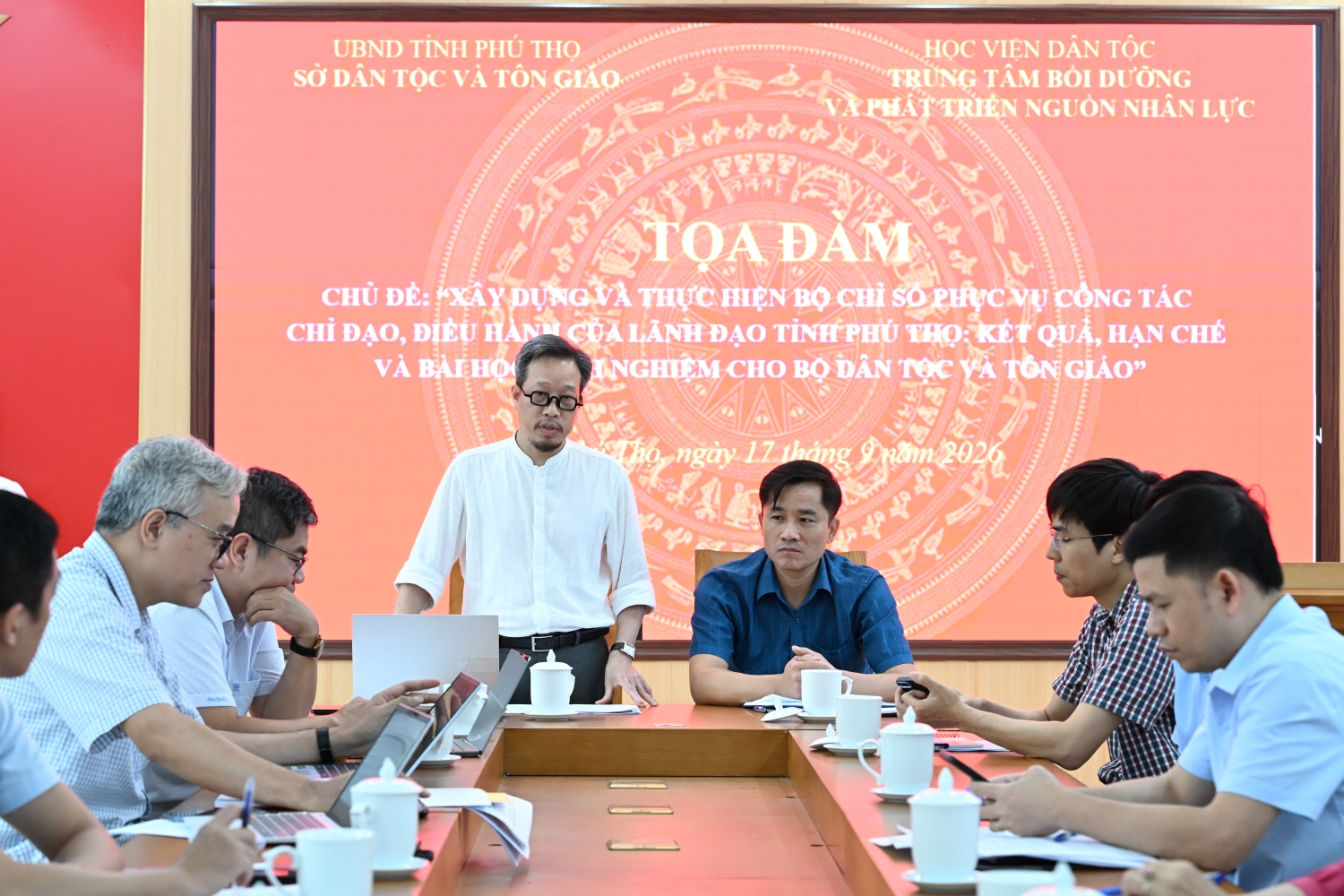
Dr. Lê Trung Kiên concludes the seminar
Based on the multi-dimensional discussions in Phu Tho province, the process of designing and developing the Set of Indicators serving the direction and administration of leaders of the Ministry of Ethnic and Religious Affairs in the digital environment should focus on four core orientations:
First, system development must begin with the political determination of the head of the agency in directly shaping the governance problem and clearly identifying the core indicators required for decision-making.
Second, the Ministry should promptly develop and promulgate a shared data framework that uniformly stipulates catalogs, identification codes, and information field structures prior to application development. Such standardization is a prerequisite enabling localities to proactively prepare primary data, thereby preventing technical incompatibility or repeated data structure revisions that waste resources.
Third, the indicator system must feature clear data tiering coupled with strict security mechanisms. Indicators concerning socio-economic development, disbursement of National Target Programs (NTPs), places of worship, and legally recognized religious organizations should be visually digitized on the dashboard to serve general governance. Conversely, specialized operational data must be safeguarded with transmission encryption, authentication, and strict access authorization in accordance with legal regulations on the protection of state secrets.
Fourth, the Ministry should prioritize the principles of data inheritance and automated inter-sectoral connectivity to minimize manual data entry burdens on the grassroots level. The list of executive indicators should be distilled to approximately 30 to 50 key indicators that are highly measurable and continuous. Local update frequencies should be designed on a monthly or quarterly basis, alongside step-by-step research into applying artificial intelligence to support the automation of administrative statistical processes.
Thuan Linh
THỐNG KÊ TRUY CẬP
Số lượt truy cập hiện tại: 41
Tổng số truy cập: