

Building a core network and digitizing legal knowledge: A new approach to law dissemination and education in ethnic minority and mountainous Areas
11:23 AM 17/06/2026 Views: 56 PrintDecision No. 233/QĐ-TTg dated February 5, 2026, issued by the Prime Minister approving the Project on “Law Dissemination and Education Tailored to Target Groups and Localities in Ethnic Minority and Mountainous Areas for the 2026–2035 Period” calls for comprehensive reform of law dissemination and education, not only in terms of communication content but also approaches, implementing personnel and communication platforms.
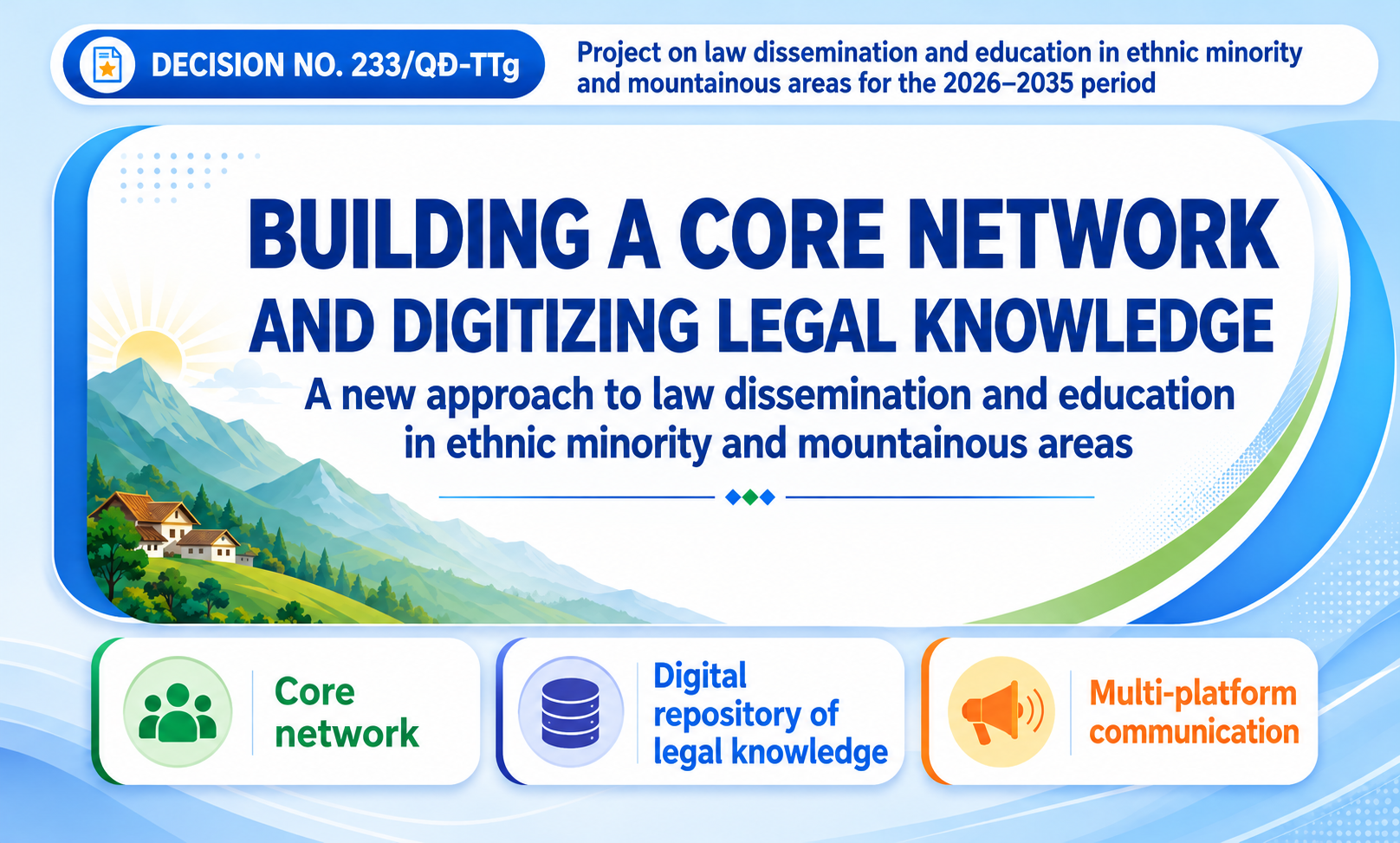
As digital transformation is becoming an important driver of national governance, the development of a core network, the digitization of law dissemination and education programs and materials, and the promotion of digital transformation in legal communication need to be regarded as closely interconnected and mutually reinforcing core components.
From law dissemination to enhancing access to law
A notable feature of Decision No. 233/QĐ-TTg is its grassroots-focused and people-centered approach, under which relevance to target groups, localities, customs, practices, languages and conditions for receiving information is treated as an important criterion.
In ethnic minority and mountainous areas, law dissemination and education cannot be limited to the one-way transmission of legal documents. For laws to become part of everyday life, content must be easy to understand, remember and apply; communication methods must be accessible and flexible; and communicators must be trusted, understand local cultures and be capable of connecting State policies with the practical needs of local people.
Decision No. 233/QĐ-TTg therefore identifies the building, development and capacity enhancement of a core network as a key task. Members of this network are not simply those who “bring the law to the people”; they also help explain and provide guidance on legal matters, identify difficulties and relay legal needs from the grassroots. This will help shift law dissemination and education from broad-based dissemination to more targeted communication aimed at specific audiences and supported by feedback mechanisms.
Core network: a bridge connecting law, trust and community culture
Under the Project, members of the core network should be selected from people who possess legal knowledge and understanding, are familiar with local customs, practices and traditional cultures, and enjoy prestige in their communities. Priority should be given to those who are able to use ethnic minority languages.
This approach is appropriate because in many remote, border and island areas, people receive information not only on the basis of legal reasoning but also through the trust they place in those delivering it.
Members of the core network may include Party cell secretaries, village and hamlet heads, prestigious people, part-time grassroots personnel, religious dignitaries and deacons, heads of religious organizations, legal rapporteurs, law communicators, or individuals who actively participate in community activities. With systematic training, they can become important points of contact between State policies and laws and the everyday lives of local people.
Importantly, these members need not only legal knowledge but also modern communication skills. Decision No. 233/QĐ-TTg introduces requirements for training in the application of information technology, artificial intelligence and social media to law dissemination and education.
This is particularly relevant today, as many people, including those living in remote areas, increasingly access information through smartphones, social media and online community groups. If members of the core network are proficient in digital tools, they can communicate legal information in more concise and engaging forms, such as short videos, infographics, audio bulletins, legal stories, question-and-answer scenarios, livestreamed dialogues and community Zalo groups.
In the new period, therefore, members of the core network should no longer be merely face-to-face communicators. They need to become community-level legal communicators who can directly explain policies, make effective use of digital resources and disseminate authoritative information in the online environment.
Digitizing law dissemination and education programs and materials: building a shared legal knowledge repository
One specific target set out in Decision No. 233/QĐ-TTg is to digitize 70% of the Project’s law dissemination and education programs and materials during the 2026–2030 period and 100% during 2031–2035.
This is a fundamental task, as only when materials are digitized, standardized and appropriately made available to the public can law dissemination and education be implemented on a broad, rapid and coordinated basis, with its effectiveness measurable.
Digitizing law dissemination and education materials should not simply mean converting paper documents into PDF files. Genuine digitization should involve restructuring and editing content at different levels of accessibility: full versions for officials and legal rapporteurs; summaries for grassroots law communicators; question-and-answer versions for the public; graphic, video and audio versions for mass communication; and bilingual or ethnic minority-language versions for relevant localities.
When the same policy or legal provision is designed in different layers of information, each target group can access it in a manner best suited to its needs.
In particular, digitization can help establish a shared repository of legal learning resources for ethnic minority and mountainous areas. Such a repository could focus on issues closely related to people’s daily lives, including land, marriage and family, gender equality, prevention of child marriage, environmental protection, belief and religion, legal aid, ethnic policies, social welfare policies, prevention and combat of human trafficking, security and public order, and the fundamental rights and obligations of citizens.
When connected with the National Law Dissemination and Education Portal, local law dissemination and education portals, the Ministry of Ethnic and Religious Affairs Web Portal and other digital communication channels, this system of materials can become an authoritative and consistent source of information that is regularly updated.
It will also help address the current situation in which materials are scattered, difficult to locate or verify, or insufficiently tailored to different target groups.
Role of digital transformation units in law dissemination and education on digital platforms
In implementing Decision No. 233/QĐ-TTg, digital transformation units can serve as focal points for technology and digital communication, helping turn the Project’s objectives into concrete products in the digital environment.
First, digital transformation units can participate in developing the architecture of data repositories and digital law dissemination and education resource libraries for ministries, sectors and localities. This includes standardizing document formats; classifying content by topic, locality, target group, language and level of use; and establishing mechanisms for updating, reviewing, storing and sharing materials among units under ministries, central agencies and local authorities.
If effectively implemented, each law dissemination and education program or material will no longer be merely an internally circulated document, but a digital resource that can be searched, reused, extracted and distributed across multiple platforms.
Second, digital transformation units can coordinate with specialized units to convert legal materials into digital communication products. Lengthy and difficult-to-access content should be edited into news stories and articles, infographics, short videos, podcasts, question-and-answer features, legal scenarios, legal stories or interactive quizzes.
This is an important step because people in the digital environment generally consume information that is quick, concise and visual. If materials are posted only as lengthy texts, their reach and impact will inevitably be limited.
Third, digital transformation units can support digital-skills training for members of the core network. Training should cover skills in accessing digital materials, using social media safely and effectively, designing concise messages, identifying and addressing misinformation, applying artificial intelligence tools to summarize, edit and convert document formats, protecting personal data, and ensuring information security when communicating legal information online.
With adequate digital skills, grassroots communicators will not simply receive materials from higher levels but will also be able to proactively disseminate information tailored to the communities they serve.
Fourth, greater attention should be paid to measuring the effectiveness of law dissemination and education. On digital platforms, effectiveness should be assessed not only by the number of conferences and training courses organized or materials distributed, but also through reach, views, shares, questions raised, interaction levels, topics attracting the greatest interest, localities with high information needs, and the most effective times for communication.
Such data will enable management agencies to adjust communication content, formats and channels more appropriately, avoiding overly broad or merely formalistic dissemination.
Fifth, digital transformation units can help ensure the authoritativeness, security and consistency of legal information. In the online environment, false, manipulated or distorted information about policies can spread rapidly, particularly on sensitive issues relating to ethnicity, religion, land and social security.
Law dissemination and education on digital platforms therefore requires mechanisms for source verification, content review procedures, rapid-response arrangements and a sufficiently strong network of official channels so that people can easily access and verify information.
Some solutions for implementation
For Decision No. 233/QĐ-TTg to be implemented substantively, implementation should closely follow the Project’s four key groups of tasks and solutions while translating them into activities appropriate to the development of the core network, the digitization of law dissemination and education programs and materials, and the role of digital transformation units in legal communication on digital platforms.
First, law dissemination and education in ethnic minority and mountainous areas should be placed under the regular leadership and direction of Party committees and authorities at all levels. It should also be identified as an important and long-term political task associated with socio-economic development, national defense and security, strengthening the great national unity bloc, and improving public awareness of and compliance with the law.
Based on the tasks assigned under Decision No. 233/QĐ-TTg, agencies and units should develop specific implementation plans clearly identifying lead focal points, coordinating units, expected outputs and completion deadlines.
Law dissemination and education should be integrated into programs, plans and projects relating to ethnic affairs, religious affairs, digital transformation, policy communication, administrative reform and digital government development.
Leadership and management should shift from administrative and campaign-style approaches to implementation driven by clear objectives, data, monitoring and evaluation, and specific communication products.
Digital transformation units should be recognized as an important supporting force in advising on methods for implementing law dissemination and education in the digital environment; developing infrastructure for data storage and sharing; supporting the design of dedicated pages and sections; developing multimedia communication products; and monitoring and measuring the effectiveness of people’s access to legal information across different target groups.
This is essential to ensure that the leadership and direction of law dissemination and education does not end with the issuance of documents, but is translated into digital communication channels, digital data and digital products that directly serve the public.
Second, the core network should be developed to include people who understand both the law and the customs, practices and traditional cultures of ethnic minority communities; enjoy prestige in their communities; are capable of using ethnic minority languages; and possess skills in communication, public mobilization, dialogue and the handling of practical situations.
The selection of core network members should extend to people who maintain close contact with local communities, including Party cell secretaries, village and hamlet heads, prestigious people in the community, part-time personnel at commune, village and hamlet levels, religious dignitaries and deacons, heads of religious organizations, legal rapporteurs, law communicators, grassroots mediators, mass organization officials and other active members of the community.
With systematic training, these people can become a bridge between the State’s policies and laws and the everyday lives of local residents.
Alongside legal training, particular attention should be paid to strengthening the digital skills of core network members. Training should include skills in accessing digital repositories of law dissemination and education materials; using smartphones, social media and online platforms to convey legal information; identifying false and harmful information in cyberspace; protecting personal data; and appropriately applying digital and artificial intelligence tools to summarize materials, prepare question-and-answer content, design concise messages, and create communication products that are easy to understand and remember.
Digital transformation units can help develop online training programs, electronic learning repositories, tutorial videos, interactive question sets and sample materials for the core network.
This will enable training to extend beyond centralized courses and be maintained on a regular and flexible basis, while reducing costs and better accommodating large geographical areas with difficult transport conditions.
Third, Decision No. 233/QĐ-TTg requires innovation in the content, methods and forms of law dissemination and education, including the development and digitization of programs, materials and content tailored to different target groups and localities.
This should be regarded as a fundamental task in creating an authoritative and consistent source of legal information that is easy to access and capable of reaching a wide audience in the digital environment.
Digitizing law dissemination and education programs and materials does not simply mean converting paper documents into electronic versions. It should involve restructuring content.
The same policy or legal provision should be provided in different versions tailored to specific user groups: full versions for officials and legal rapporteurs; summaries for grassroots law communicators; question-and-answer versions for the public; infographics, short videos, podcasts, audio materials, sketches and legal scenarios for mass communication; and bilingual or ethnic minority-language versions where appropriate.
Content should be concise and easy to understand, while focusing on practical issues such as land, marriage and family, gender equality, prevention of child marriage, legal aid, belief and religion, social welfare, ethnic policies, environmental protection, security and public order, and the fundamental rights and obligations of citizens.
Digital transformation units have an important role to play in standardizing formats, classifying data, building digital repositories and ensuring that law dissemination and education materials can be searched, updated, shared and reused.
They should also participate in developing dedicated pages and sections on law dissemination and education and connecting content with the Ministry of Ethnic and Religious Affairs Web Portal, the National Law Dissemination and Education Portal, local law dissemination and education portals, and appropriate social media platforms such as YouTube, Facebook and Zalo.
Every digital communication product should include a link to an official source, enabling people to access and verify information easily and reducing the risk of exposure to misinformation.
At the same time, communication methods should be renewed with legal scenarios placed at the center. Instead of merely disseminating provisions by listing articles and clauses, law dissemination and education content should be transformed into stories, cases and situations commonly encountered in everyday life.
This approach is consistent with the way people at grassroots level receive information and also makes materials easier for members of the core network to use in face-to-face communication or on digital platforms.
Fourth, to ensure effective implementation, inspection, supervision and evaluation should be conducted regularly and substantively, with a focus on concrete results.
Evaluation should not be limited to the number of conferences and training courses organized or materials distributed. Additional criteria should be introduced to reflect the effectiveness of people’s access to the law and the extent to which the core network is fulfilling its role.
A set of monitoring indicators could include the number of core network members recruited and trained; the number of law dissemination and education materials digitized; the number of digital communication products published; numbers of visits, views, downloads and shares; questions and feedback received from the public; the number of localities using digital resource repositories; the number of dedicated pages and sections maintained; the number of law dissemination and education activities conducted online; and the suitability of materials for individual target groups and localities.
Digital transformation units can support the development of data dashboards, statistical tools and periodic reports, while analysing trends in public interest by topic, locality, time and target group.
On that basis, management agencies can promptly adjust communication content, focusing on legal issues of greatest concern to the public or on localities where access to legal information remains limited.
Alongside inspection and evaluation, attention should be paid to reviewing successful models and effective practices, as well as promptly commending and rewarding collectives and individuals that make positive contributions to the implementation of the Project.
Effective grassroots models should be selected and replicated, including community legal groups, legal information sections in ethnic minority languages, short videos based on legal scenarios, electronic law libraries, digital legal access points in villages and hamlets, and models in which members of the core network assist people in accessing legal materials online.
Decision No. 233/QĐ-TTg introduces a new approach to law dissemination and education in ethnic minority and mountainous areas.
Its four groups of tasks and solutions are closely interconnected: leadership and direction provide the necessary enabling conditions; the core network constitutes the direct implementing force; content digitization and methodological innovation provide the foundation for more effective communication; and monitoring and evaluation serve as tools for adjustment and quality assurance.
When these tasks are implemented in a coordinated manner, law dissemination and education in ethnic minority and mountainous areas will gradually shift from traditional dissemination methods towards a modern, flexible and interactive model of legal communication that is data-driven and better suited to people’s needs in the new period.
Thành Long
THỐNG KÊ TRUY CẬP
Số lượt truy cập hiện tại: 39
Tổng số truy cập: